Rofo Space Case: Perusing the Roost
Rofo caught up with Roost.com CEO Alex Chang to get the latest on life at the office. The residential real estate search engine will soon be vacating their executive office suite South of Market to move in to a Class A high rise in San Francisco’s financial district. Chang shares his perspective on the beauty of the short-term sublease and the increasingly important value he places on location and office ambiance.
Roost.com Office Space Interview with Roost CEO Alex Chang
Roost.com Office Space Tour
Roost is a search engine for homes. Roost is a way for the average consumer to find their next home to buy, and what makes us special is we give the consumer a really easy and fun way to search through great, comprehensive information that they can trust. So we partner with local Multiple Listing Services, and as a result the consumer gets access to all the current listings as opposed to a portion of the market.
How many employees do you have?
16
Tell me a little bit about about the office you’re in now:
We’re in a Regus office space in downtown San Francisco. It’s a big, open floor plan feel with a few semi-private offices but there are no ceilings, the walls are very thin so you can hear everything that’s going on in the office, which is good we like that environment. It’s on Folsom between third and fourth, which is a terrific location on a bunch of levels.
Tell me why you like the location:
The things that were important to us when we were looking for office space were really location so that it was convenient for our folks from all over. We’ve got a bunch of people in the east bay, south bay and people in the city. We’re three blocks from BART, Muni and a pretty easy walk from Caltrain so it’s a good commuting location and it’s a good walking distances to places to eat and bars. It’s just very convenient.
Tell me about the executive suite experience. What are the pros to it and what are the drawbacks you’ve found:
It’s like staying in a hotel. It’s great, the space is nice, it’s a great location, we have a lot of flexibility in the lease period which I wanted to have as much optionality in the term of the agreement as we could have so it’s great on all those levels. It’s a little bit like a hotel in terms of a lot the services are packaged with it and you tend to pay a little bit of a margin for those services. But it’s been a good experience.
Moving? What prompted your decision to move?
I think a couple of things. First of all, we felt like we started to outgrow this type of floor plan. We wanted a floor plan that would grow more with us. And then secondly, some of the things we’re missing here are our own private conference rooms, our own private kitchen, and we wanted to get in to that type of stuff.
When you moved into this space, how many employees did you have? What were your plans for growth?
We’ve probably got just about the same number of employees than we had when we moved in and that’s another reason to move is so that we have more space to scale. Here, we could add 4-5 more folks but not much beyond that. So we need to be able move into a place where we have a little more long-term flexibility.
How did you find the space you’re moving to?
Broker. We used a commercial broker. We’ve used the same couple brokers, this will be our third office space with them. One at a previous start-up and then this company (Roost) was in another space before this.
Can you tell me a little about the space you’re moving to and how it’s different from this space?
It’s class A building. It’s actually the McKesson building at One Post. We’re in a sublease there. The building itself sits on top of the BART and Muni stop which is terrific for all our guys. You don’t have to brave the elements if it’s raining and there’s no walk so that a huge selling point. It’s also a great location in terms of restaurants and bars and all that stuff. The space itself, it has a large war room area that we can use to do big conferences, and the rest of it is open space. So it’s just a nice mix of individual and group space.
How long is that sublease?
Two years. I’m a huge fan of having flexibility. I don’t like to lock into a long term as much as I can possibly avoid that because who knows, we might 10x in size if we really get it right and I don’t want to be locked into a contract that I can’t easily affect.
Tell me about professional services, experts you used along the way…
Our CFO has typically led the charge on looking for space, and we’ve used commercial brokers every time. It’s just felt like a more efficient way to go. We’ve looked a little bit on our own. But typically, in the commercial market, I’ve found that the commercial brokers have access to information quicker and have a better landscape than you would if you didn’t use one. And we always put the contracts through out attorney.
Who is organizing the move into your new space?
A little bit of me, a little bit of our CTO, a little bit of our CFO. We’re a start up so we do it all. I’m taking out the trash too.
Were there any lessons learned from your previous move into this space that that you turned to when looking for this next space.
I’d say three things. First of all, I mentioned flexibility before. When we moved into this one, most of the office spaces on the market, really wanted a three, four, five year deal. I just felt like that was a bad move. I felt like I didn’t want to get locked in for that long and I’m glad I didn’t. I’m glad that I made sure that we had flexibility after 18 months or so because it’s really to know what the future’s going to hold. So we made sure to do that again and did not go to anything that was going to be a three-year deal.
I think the other thing that you underestimate is what’s the day-to-day work environment in the office going to be like. So, as much as an open floor plan is great, it’s also loud. And I don’t know that I’d pictured that coming in so I thought a little more about that when we started looking for more space. What was it actually going to be like when we lived in the space.
And then Transportation. Again, I think if you look at the progression of office space that I’ve moved into with companies, it’s gotten more and more convenient every time. It’s hard to overestimate the value of convenience for the people on your team especially if they they’re working long hours.
Signs of life for the Oakland Retail Market
We saw a couple of articles posted last week on a Walgreen’s retail lease in Oakland City Center. Walgreen’s as reported by Globest signed a lease in the former Gap space located at 1333 Broadway in Oakland.
The reason this story caught our eye was that Walgreen’s simply moved across the street from 1330 Broadway in Oakland. My guess is that someone involved in the lease must have pumped out a press release making the announcement. Because otherwise it just doesn’t seem to be all that newsworthy which, reading between the lines, spells continued goods news for tenants looking for commercial real estate to lease.
Introducing QuickMove – Rofo’s Answer to the small office move
Have you moved your company recently? Pulling off a commercial move isn’t the most complicated task but it sure is a pain when your trying to keep focused on priorities.
And when you’re a small or young company who do you delegate this task to? You.
The reason is simple. While moving is tedious and time-consuming it can also be costly if you make the wrong decision or fail to identify all of the necessary tasks. And because your move is directly related to your specific office space it means that no two moves are alike. So the last thing you need is another generic checklist telling you to plan ahead.
Rofo introduced QuickMove to solve this problem. We identify all of the categories of tasks you will likely encounter and provide you with the local vendors to help you complete your move and office set up. We also offer a move concierge (think of this like your own personal move coordinator) who can provide quick answers or takeover the entire project and allow you to focus on your business.
Rofo Office Space Case: A Visit to Tripit
If you’re a globetrotting exec or are trying to plan a vacation with friends to a far-flung destination, chances are you know how difficult it can be to keep everyone apprised of your ever-changing travel plans. Enter upstart, Tripit. This fast-growing San Francisco company developed proprietary technology to power its Itinerary Management Service. Their dynamic service not only enables travelers to stay organized, but they can easily share their information with those who need to know.
When searching for San Francisco office space in 2007, Tripit’s founders zeroed in on finding a well located, functional and flexible work environment that fit their budget.
We caught up with Tripit’s President, Gregg Brockway, to get his take on which priorities factored into their decision on where to hang their shingle. Below are some clips from the interview followed by the entire transcript. Tripit is the first of many companies we will be profiling this series. If you have a story to share about your company and location (or you just want to show off your space) please contact me at: my first name at rofo dot com.
Key criteria in choosing your space:
Lessons learned:
Tripit Space Tour:
Rofo: Tell me about Tripit.
Gregg Brockway (GB): Tripit is an itinerary management service. We help people book anywhere and organize all of their information into a single master itinerary once that information is all in one place, we make it really easy to share that information with the people who need to know or interact with the applications that they like to use. So they can sync it to their calendar, they can get the information on their mobile phone and there are lots of neat third party applications that plug in to Tripit too that make the information more valuable.
Rofo: Where’s your office?
GB: We’re in the Potrero Hill neighborhood in San Francisco, which is full of Start-ups. Historically, it was the Design Center, so it’s got a nice feel. There are lots of interior designers and furniture showrooms located here so it’s very creative. More recently, you’ve seen lots start-ups move into this neighborhood, because it has good transportation, free parking and some good places to eat. It also happens to be one of the less expensive neighborhoods in San Francisco.
Rofo: What attracted you to this space?
GB: We’ve been in our space for about two years and the first thing that I liked about the space was the location. If you look out this window, you can see the public transportation and if you look out this direction, you can see the Anchor Steam Brewery, a fabulous San Francisco landmark. We’re really fortunate because shortly after we moved in, Whole Foods opened next door, so from a location perspective, it was very attractive. It also happens to be a neighborhood where there’s lots of free parking so for commuters this was a good set up.
Rofo: Any Shortcomings with the space, or anything you wish you could change about it?
GB: Boy, finding the right place is one of the hardest things about starting a new company. At my last company, we signed a lease at the peak of the market and watched over the next seven years as rents declined each and every year. Figuring out where you are in that cycle and how much space you’re going to need over the short, medium and long term is really hard to predict when you’re a start-up company. Making that commitment and signing an extended lease can be a nerve racking experience. It’s money you don’t have. If you get too much or if you get too little you outgrow it and you have to move. Either of which is not a good situation. What we were looking for was a short-term lease in a space that we thought was big enough to let us grow but not too expensive so that we weren’t locked in to something.
Rofo: How’d you do?
GB: I think we did OK. We tried lots of different avenues to find the right space. We talked to some brokers. We ultimately were most successful by going directly and reading through Craigslist. I think there are some newer services today, like Rofo, that would be super helpful. It didn’t exist when we were looking for space so we did it the old-fashioned way: we got out and hussled and pounded the pavement until we found something that worked. It was not a very efficient process.
Rofo: What were some lessons learned and how would you go about the process differently the next time around?
GB:
#1: Sizing the space is definitely one of the first challenges. If you’re an early stage company, the shorter (the lease) the better. You just never know how things are going to turn out. We are in a good space but we’re going to be bursting at the seams here very soon. But we need to be in this space through September (of 2009). Fortunately, I think we’re going to be looking for space in a good environment.
#2: Signing a lease. I’ve done a lot of contracts in my life but I haven’t signed very many leases. We learned a few things the hard way. It’s actually very easy to do a sublease because you basically assume the terms of the person who had the lease before you did. When we went to renew our lease with the landlord, I found out about a little thing called base rate and base rate changes from one year to the next. We signed (a lease) at the end of 2008 at a 2008 base rate. I thought that was what I was going to be paying for the next year but I got a rental increase notice basically 90 days later that my rent had just gone up 12%. For experts in the field, this was something to be expected. For me, it was definitely not something I had anticipated. Even if you pay attention to the details, there are little “gotchas” in the lease. I’ll definitely run it by a professional next time I sign a lease.
Rofo: What unique characteristics about your business played a role in selecting this site?
GB: We were looking for an open space. I really like an open floor plan where people can hear what’s going on in the office. It makes communication really efficient and in a small company that’s moving fast, that can save a lot of time. Having everyone in offices with doors closed can really stifle the creativity and the free flow of information. We were looking for a nice, well lit, well located space where everyone could sit out in an open floor plan and that was really important to the kind of culture we’re trying to build at Tripit.
Finding Office Space – The Case For Video
In the world of commercial real estate there’s a lot of room for improvement in the area of content and data. And when you mention data everyone always goes to research and analytics. What we think of is data and content related to marketing a commercial space. Businesses want to understand the characteristics of a space before they go see it. They also want to know characteristics about the space and building in the context of running a business.
Common questions:
How will my employees commute to this space?
Are there local amenities?
How good is the building security?
Rofo is aggressively encouraging and promoting the use of video to market office space. The reason is that we’ve witnessed incredible results for both businesses and landlords when video is used. Office space listings like the one at 182 2nd Street in San Francisco are getting far more views and inquiries. We will soon be showcasing the listings with video on Rofo knowing the help it provides to both parties. translator directory .
The Brokers’ View of the San Francisco Office Space Leasing Market
Rofo was recently included in a story about the market for San Francisco office space. The story line is still the same – doom and gloom for the landlords and professionals who rely on commercial real estate transactions to make money. To sum it up: as a business/entrepreneur you are in the driver’s seat. You can now succeed at getting a short term deal, cheaper rents and other concessions like free rent and allowances. But obviously the deals are attractive because the overall business climate is in the dumps. So what to do? If you have a lease expiring in the next 12 months now is a good time to start evaluating your options. Just like its a very good time to hire its also a very good time to either negotiate and lock in a low rent in your current office space or shop around and upgrade your diggs.
San Francisco Commercial Real Estate is a Buyer’s Market in Downturn from VidSF on Vimeo. .
San Francisco Commercial Real Estate Facts and Figures
Thank you to Paul Picciani for submitting his latest San Francisco Street Beat newsletter. The newsletter always contains some great local building trivia as well as some insightful stats on the San Francisco Commercial Real Estate market. Its helpful info for any company considering a move as it breaks out recent lease rates by building class. Visit Paul’s profile page on Rofo to get a hold of him and get on his mailing list. Below are some of the rates he breaks out for downtown San Francisco:

Further Simplifying the Search For Office Space
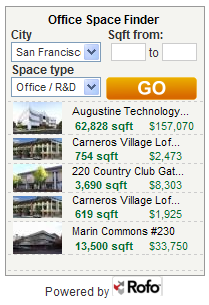
We’re up to about 10,000 commercial real estate listings on Rofo. For an entrepreneur it’s nice to have all the of local listing information in one place – and easy to search. Now we’re making it even easier with the Rofo widget. Our widget allows you, the entrepreneur, to see local office space listings on sites like Square Feet Blog.
Rofo on Crunchbase
Retail Rap – San Francisco Retail Space Summary
 We are at a point of transformation…and dreaming and creating change is the American way. Many store and restaurant closing were announced for January. San Francisco restaurants brought 35 closings in January. Yet many establishments continue to have lines out the door at lunch, and 45-minute waits for dinner. Many companies are using the economic downturn as a moment to take overdue action. Upon announcing a 7,000 job cut overhaul, Macy’s chairman Terry J. Lungren said, “Now I think is the time to address all of those structural changes that are required.”
Comparisons have been made to the sluggish economy of the ‘70s. When you think about it, that counter-culture era produced some pretty cool and long-lasting concepts: Apple, Southwest Airlines, Genentech, Microsoft. Concepts emerged then that were willing to experiment with alternative ways of doing business while incorporating proven fundamentals, like: Banana Republic, Body Shop, Whole Foods, Urban Outfitters, Dean and Deluca and Quiksilver. We got some great music out of it too: jazz fusion (Weather Report), jazz funk (Herbie Hancock), psychedelic funk (Sly and the Family Stone, etc.)…and Prince. Hollywood took a risk on an untested director with the Godfather. Oh…and the food revolution started by the little restaurant in Berkeley – Chez Panisse.
Consumers are looking to make meaningful purchases with their disposable income…and this gives rise to the new ideas and growing concepts we see coming our way. While a significant part of the retail downturn is due to the financial meltdown, a contributing piece is that there was just too much disposable look-alike junk in the market—quite different from the emerging trends of green and long-lasting ‘feel good’ purchasing.
While San Francisco retail space is experiencing its share of retail and hospitality downturn, as a leader in counter-culture, it bucked retail rent and vacancy trends with year end 2008 retail vacancy down to 2 percent and average asking rents ending up 5.6 percent to $40 psf. The downturn ignites the creative innovation for new concepts to emerge as entrepreneurs turn unemployment into opportunity. We are seeing a continued rise in interest from food (it is the Bay Area!), fitness, wine bars, self improvement and green-themed local concepts.
Bay Area unemployment is up. Bay Area officials have requested $6 billion of infrastructure projects that would generate nearly 27,000 jobs from the economic stimulus package now moving through Congress. The Bay Area hopes to move in new directions through investments in transit and walkable, sustainable communities, instead of the suburban sprawl infrastructure of the past.
Rhonda Diaz is Vice President of the Urban Retail Group at Terranomics